What is Chikungunya?
Chikungunya is a mosquito-borne virus that has been around a long time but remained obscure until it reemerged from Africa in 2004. Then, as viruses do, it started to spread - to the Indian Ocean and then Asia. In 2013 the first locally acquired case was reported in the Western Hemisphere.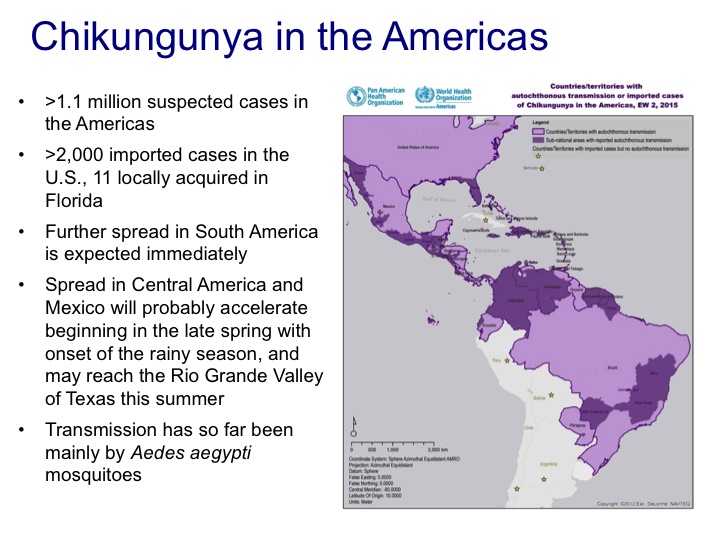
Locally acquired is the key here. As opposed to an "imported case," this means the virus is now circulating well enough to infect the local population through mosquito transmission.
Symptoms appear about three to seven days after being bitten by an infected mosquito. The most common symptoms are fever and severe joint pain, often in hands and feet, and may include headache, muscle pain, joint swelling, or rash.
Most patients will feel better within a week but some people develop longer-term joint pain that can last weeks to months. Death is rare but can occur. People at increased risk for severe disease include newborns exposed during delivery, older adults and people with medical conditions such as high blood pressure, diabetes, or heart disease.
Dr. Scott Weaver, globally recognized for his expertise in mosquito-borne diseases, has been studying chikungunya for 15 years and is working on a vaccine. The virus is circulating through two mosquitoes, Aedes aegypti and Aedes albopictus, which bite during the day.
Weaver is the director of Institute for Human Infections and Immunity and scientific director of the Galveston National Laboratory.
Weaver was presented the 2014 Walter Reed Medal in recognition of his distinguished accomplishments in the field of tropical medicine. Weaver is an internationally recognized virologist and vector biologist who has made several important contributions to the understanding and control of tropical diseases. His work has been widely published and he holds five patents in vaccine development.
He is the co-chairman for the Global Virus Network's Chikungunya Task Force, which formed to speed the process to creating vaccines and much-needed diagnostic tools for this virus, as well as to advocate for research efforts. Chikungunya has been identified in dozens of countries across Asia, Europe, Africa, and is now spreading in the Americas.
Weaver's Chikungunya research
World Class Research Centers
UTMB's infectious disease research is coordinated through the Institute for Human Infectionsand Immunity, home to more than120 faculty actively engaged in research. The IHII's premiere research facility is the Galveston National Laboratory, which includes the largest fully operational Biosafety Level Four laboratory on an academic campus in the U.S.
The IHII includes the Sealy Center for Vaccine Development, one of the most comprehensive vaccine development centers in the world, whose researchers are investigating new ways to treat infectious diseases of every type, from new strains of influenza to emerging diseases from every corner of the globe.
UTMB has been designated a World Health Organization Collaborating Center for Vaccine Research, only the second in the Western Hemisphere.
UTMB is also home to the National Biocontainment Training Center, which is dedicated to preparing the worldwide community of infectious disease scientists to work safely in high-containment research laboratories. This unique training opportunity is unmatched nationally or internationally and fills a critical role in the development and training of a cadre of skilled scientists, engineers and staff dedicated to combatting the infectious diseases affecting global health.
Selected News highlights
- Yahoo Health, Dec. 30, 2014: The new health threats you'll be seeing in 2015
- NPR Houston, Dec. 24, 2014: Tropical checklist should include Chikungunya precautions
- BioNews Texas, Nov. 10, 2014: UTMB scientists awarded for outstanding work on tropical diseases
- Scientific American, Nov. 4, 2014: New type of more problematic mosquito-borne illness detected in Brazil
- Florida Keys Keynoter, Oct. 3, 2014: Locally acquired Chikungunya has arrived here
- Bloomberg Businessweek, Oct. 1, 2014: Mosquito virus that walloped Caribbean spreads in U.S.
- Men's Health, Sept. 2014: The agony virus
- Houston Chronicle, Sept. 26, 2014: Mosquito-borne virus spreading rapidly in Latin America
- Medscape Medical News, Sept. 23, 2014: Chikungunya virus concern growing
- Charleston Post Courier, July 21, 2014: Mosquitoes and disease in the low country: Types, risks and prevention
- NBC News, July 17, 2014: It's here: First local chikungunya cases in Florida
- NPR Houston, July 8, 2014: Texas case raises concern over chikungunya virus reaching U.S.
- NBC News, July 3, 2014: Bugs at your July 4th BBQ? Beware of chikungunya and West Nile
- The Hindu, June 25, 2014: 'Super-adapted' Chikungunya virus a possibility
- Voice of America, June 18, 2014: African viral disease spreads
- BioNews Texas, June 17, 2014: Galveston researchers warn of potential mutant Chikungunya virus epidemic
- The Washington Post, June 5, 2014: The next mosquito-borne infection you might want to start worrying about
- Palm Beach Post, June 2, 2014: Palm Beach County joining efforts to fight mosquito-borne illness chikungunya
- Miami Herald, May 31, 2014: Mosquito-borne virus could become public health nuisance for Florida
- Science, May 16, 2014: Crippling virus set to conquer Western Hemisphere
- BioNews Texas, April 8, 2014: Leading viroligists collaborate to address new Chikungunya viral disease threat
- Phys.org, April 7, 2014: Leading virologists join together to address urgent viral threat
- New Scientist, March 12, 2014: Chikungunya may explode with rainy season
- KPRC-TV (NBC 2 Houston), Feb. 27, 2014: Painful disease spread by mosquitoes will likely spread to Texas